Facebook
 X
X
 Pinterest
 Copy Link
Low Appraisal: What Are the Buyer’s Options?
What happens if a home appraises lower than the agreed purchase price—and can the buyer back out automatically?
If a home appraises low, buyers typically have several options—but whether you can walk away depends on your contract, specifically the appraisal contingency.
Why Appraisals Matter in a Real Estate Transaction
When you’re buying a home with financing, your lender requires an appraisal to confirm the home’s value.
If the appraisal comes in at or above the purchase price, everything moves forward smoothly.
But if it comes in low, it can create a gap between:
- What the home is worth (according to the appraiser)
- What you agreed to pay
That’s when understanding low appraisal: what are the buyer’s options becomes critical.
Can a Buyer Back Out Automatically?
The short answer: not always.
Your ability to back out depends on whether your contract includes an appraisal contingency.
With an appraisal contingency, you typically have the right to:
- Renegotiate the price
- Ask the seller to make adjustments
- Or walk away and retain your deposit
Without that contingency, backing out becomes more complicated—and potentially costly.
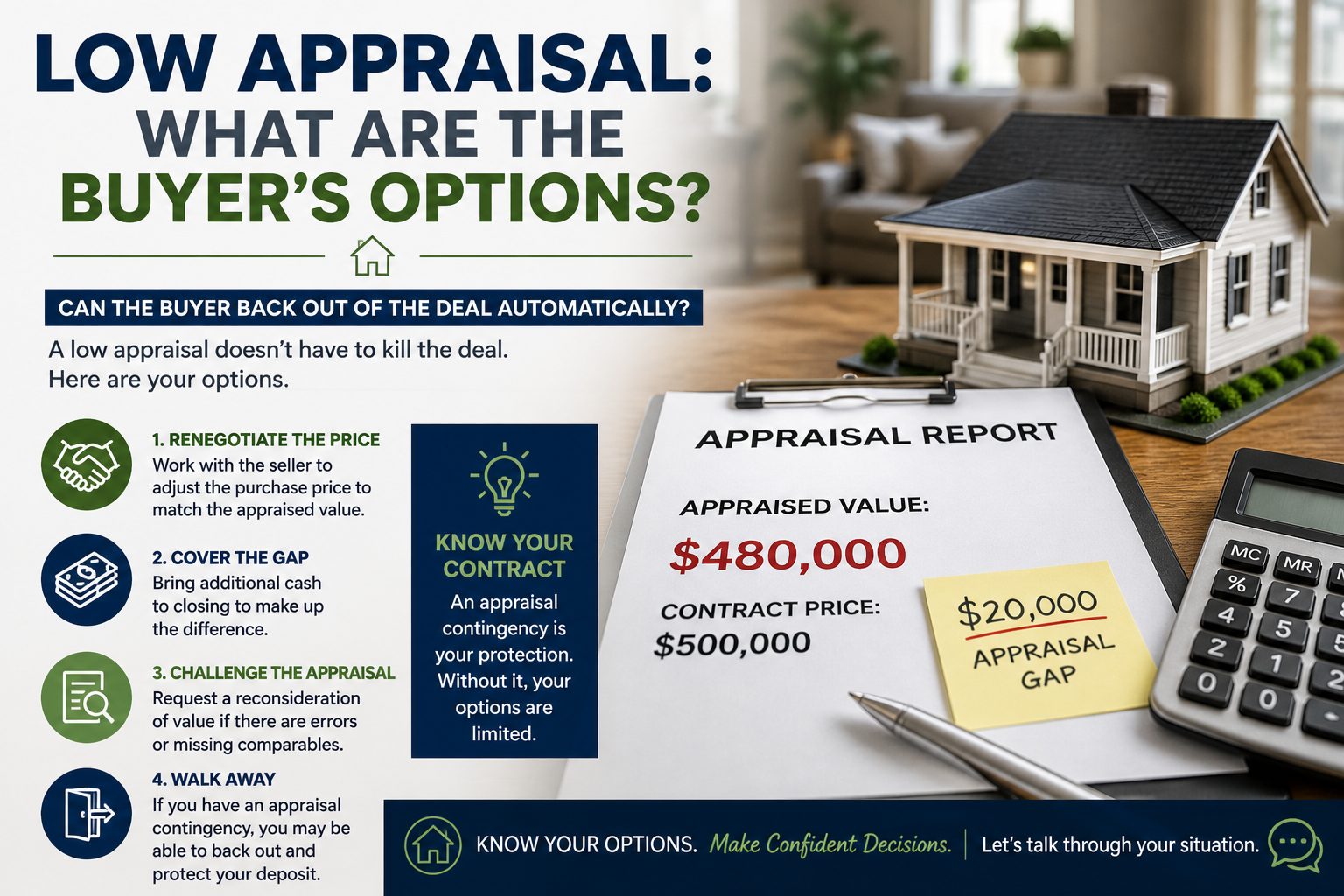
Option 1: Renegotiate the Purchase Price
One of the most common outcomes is renegotiating the price to match the appraised value.
This works best when:
- The market supports the appraiser’s valuation
- The seller is motivated to keep the deal together
In many cases, both parties meet somewhere in the middle.
Option 2: Cover the Appraisal Gap
If you still want the home, you may choose to make up the difference out of pocket.
For example:
- Purchase price: $500,000
- Appraised value: $480,000
- Gap: $20,000
You can bring additional cash to closing to bridge that gap.
This option works best if:
- You have the financial flexibility
- You strongly want the home despite the valuation
Option 3: Challenge the Appraisal
In some situations, your agent can help you request a reconsideration of value.
This may involve:
- Providing additional comparable sales
- Highlighting inaccuracies in the report
While not always successful, it can be worth exploring if the appraisal seems off.
Option 4: Walk Away from the Deal
If you have an appraisal contingency in place, you may have the option to exit the deal.
This is often the right move when:
- The gap is too large
- The seller won’t negotiate
- The numbers no longer make sense for your goals
Understanding your rights here is a key part of navigating low appraisal: what are the buyer’s options.
Timing and Strategy Matter
Low appraisals can feel like a deal-breaker—but they don’t have to be.
What matters most is:
- How your contract is structured
- How quickly you respond
- How strategically you negotiate
In a market like New Haven County, these details can make or break the outcome.
Final Thoughts
A low appraisal doesn’t automatically kill a deal—but it does force a decision.
With the right guidance, you can evaluate your options clearly, protect your finances, and decide whether to move forward, renegotiate, or walk away.
Let’s Talk Through Your Options
If you’re facing a low appraisal or want to understand your options before making an offer, the best next step is a conversation.
When you’re ready, let’s connect.
Heike Severine, CT Real Estate Expert in New Haven County
📞 860-385-6315 |
✉️ Heike@CTRealEstateExpert.com
MoveMeter – Check this out!